

Community building leavened by shared faith
Interview with Gergely Prőhle
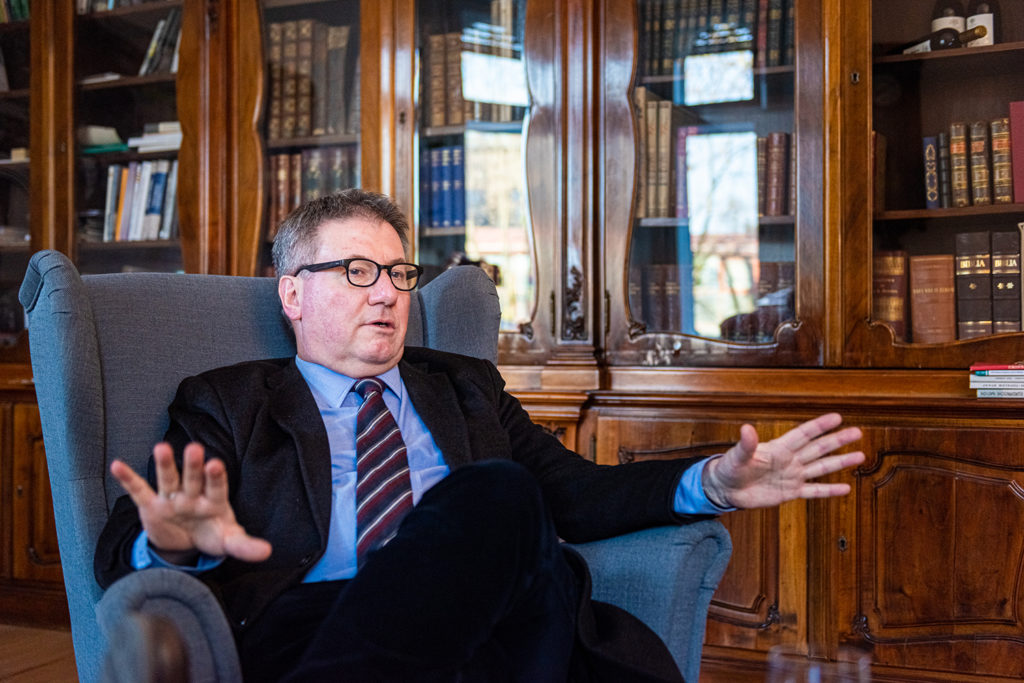
Where is our place? – This is one of the questions raised in the interview with Gergely Prőhle, Lay President of the Evangelical Lutheran Church in Hungary, former Ambassador of Hungary in Germany. Prőhle currently works as the Director of Ottó Habsburg Foundation and heads the Institute for Strategic Studies at the University of Public Service. An extended version of the interview was originally published on 24.hu.
– There is a notion around according to which cultures have been rising and falling ever since the dawn of humankind and the same fate awaits our own culture based on Judeo-Christian traditions. Therefore, we should get past the question of whether our descendants will pray in a church, a mosque or a Buddhist temple – provided they will pray at all – and be content with the thought that whatever culture they will identify with, they will be carrying our genes.
– Such blending is indeed characteristic of our civilization, but we cannot assume the attitude “what comes will come”. As Christians, we cannot be indifferent to the dilemma of whether our culture will integrate that of the newcomers or the other way round. There is some positive change in the trend: whereas in 2000 Friedrich Merz, who by the way has recently been nominated for Chairperson of the CDU, received sharp criticism for introducing the term “Leitkultur” (guiding culture), a notion referring to the primacy of traditional European lifestyle in Germany, by now the idea has become an integral part of the CDU party program. In Europe immigrants are increasingly expected to follow our lifestyle, although this ambition often falls prey to some kind of strange timidity or political correctness. Integration presupposes that the Muslim religious community accepts the common rules of the game. It is a commendable attempt that, following Austria, Bavaria is also launching the public training of imams and wants to exercise some control over this area. In this room where we are surrounded by the books of Otto Habsburg, it is appropriate to mention that the Austro-Hungarian Monarchy was also multicultural in some sense: the Islamic Act of 1913 already stated that Muslim communities were considered law-abiding, integral parts of a state with Judeo-Christian traditions. At the same time, it is true that the situation was somewhat easier at that time, because they were not clustered in the centers of the empire, in Budapest or Vienna, but in regions where they had been living for centuries: in and around Sarajevo.
– Can integration go so far that it would not be washed away by the effects of demographic changes?
– I have lived in European cities with a large number of Muslim population. I was consciously looking for encounters with them but my experiences make me skeptical about the success of mass integration, although I am aware of some impressive examples.
I am trying to approach the solution from the starting point of Christian. As a last resort, we might be comforted by the fact that the most dynamic growth in the number of Christians can be observed in Africa, so however bizarre it may sound, immigrants may finally end up being more Christian than the European natives.
In the context of migration, we might be tempted by self-excuses, but it would be self-deception to blame the decay of Christianity on the immigrants. It is certainly not the case in Hungary. In the previous two censuses the support for all historic churches fell by 30 percent each time, meaning that from one decade to the other we had 30 percent less people who declared themselves Roman Catholic, Reformed, Lutheran, etc. I have been the Lay President of the Evangelical Lutheran Church in Hungary since 2006 and in that capacity I have been trying to do my best to avoid similar tendencies to prevail in the next census due in 2022.
– What tools do you have at hand?
– Only limited ones, obviously, but diffidence is not the best option in these cases. What we have to make clear is that practicing one’s faith in a community is not an obsolete, old-fashioned thing but an important part of the modern world. Our Lutheran community has a longstanding tradition to act in that spirit, for example by operating open, high standard institutions such as some of our high schools. Our digital teaching methods also enjoy outstanding reputation far beyond Lutheran circles. Another consequence of our high-quality digital presence is that we can reach out to many people and provide support and encouragement to them in these difficult times.
– Do we need to believe in God in order to be able to preserve our culture?
– Community building is leavened by commitment that go beyond the individual. This is our shared faith that assists tolerance and the resolution of occasionally serious disagreements. What we need is not some kind of a pigeon-hearted reverence or piety but the attitude that we are ready to carry each other’s burden, tolerate or even love one another.
(…)
– Today’s world politics is ruled by the USA, China, the EU and Russia, but also India and Brazil are emerging as important powers. What can we expect in the next decades, who is going to become stronger or weaker, which countries will grow closer or apart?
– India and Brazil are populated by many people but that alone is not enough to get into the elite. Russia can be regarded as a winner of global warming, as large Siberian territories, frozen for thousands of years, are now becoming inhabitable and, even more importantly, exploitable. That does not necessarily mean that the country will be able to overcome its centuries-long structural handicap. We should also devote some attention to the developments of the recent weeks: Russia has been strengthening its cooperation with China and the emergence of the latter seems unstoppable. This all has strategic importance. The United States has maintained its position in spite of the political show and has obtained a significant head start in the field of technological innovation and research. These two countries, China and the USA have been the most successful in preparing for the future.
– What about Europe?
– Europe has grown too comfortable and it is lagging behind but by far not to the extent that is often claimed. In Germany, the country that is still the economically strongest and technologically most advanced state in the continent, huge debates are going on about the causes of the current recession. Yet, there is also agreement that it is possible to catch up again by investing large sums into the development of education and research specifically.
– Where will the funds come from?
– Angela Merkel herself talked about this and, if I remember correctly, her thoughts have been cited by Viktor Orbán, too: it is simply unsustainable that Europe, the continent inhabited by only 4% of the world population and producing no more than 12% of the total GDP, spends half of the total social expenditure in the world. In addition, the Western world is guilty of unreasonable consumption, travelling here and there (although that is past tense now) with cheap tickets, eating fresh raspberries and cherries from South America in January, or purchasing cut flowers grown in Africa in the middle of winter. All this is nonsense. And the situation is all the more tragic because most of the welfare state citizens are unwilling to understand how unfair and self-destructive these practices are.
I don’t want to read too much into the current crisis, but it is difficult not to understand the pandemic as God’s warning finger held up.
(…)
– Will there ever be a United States of Europe?
– The idea of a United States of Europe contradicts all historical experience and traditions. It is nonsense. A castle in the air.
– Should Europe become or remain a continent of nation states then?
– Of course.
– What does a Europe of nation states mean?
– By no means should it mean a dreamy gaze into the past or even less the nationalistic chest-thumping of twenty-seven member states. The Europe of nation states is actually a more sonorous expression for the notion called subsidiarity by Otto Habsburg. It is the idea that as many decisions as possible should be made at the local level where decision-making can be performed most reasonably and where the decisions itself have the most effect. This also implies that the issue of responsibility cannot be evaded on a national level either – this is what elections in the individual members states are about. All this should obviously not override European solidarity, which Hungary is clearly a beneficiary of, by the way.
– Where does the line go between a Europe of nations and nationalism? How can we make sure that the competition of nation states will not once again lead to antagonistic tension, fragmentation or a world war?
– Despite all crisis symptoms and political blockage I would prefer to be less pessimistic. After all, the European Union is a well-thought-out structure, a system of treaties thoroughly fortified by legal means. At the same time there is no doubt that these symptoms keep emerging and currently we are also observing the relative positioning of various power and interest groups.
– How specifically?
– We can see several splits. Just to mention a few examples: fiscally, there is the viewpoint of the Frugal Four, who would no longer like to put the generosity of their tax payers to the test for the sake of the noble principle of solidarity. This is practically nothing more than a new take on the old debate between the “diligent North” and the “lazy South”. Simultaneously, there is an ongoing value dispute on how to protect the traditional Judeo-Christian values against the self-surrendering multiculturalism of the West. In this conflict, we can see the reappearance of the well-known fissure between East and West with some debate added over the rule of law. Neither have we got rid of the evergreen issue of sovereignty currently manifesting itself in questions such as: who vaccinates the citizens faster, me or the union? What am I as a state capable of? Where are my limits?
– Where is Hungary headed on the periphery of Europe? Up or down?
– Odds-defying optimism makes me say the trend is going up.
– And what does your sense of reality imply?
– Hungarian foreign policy today is mainly concerned with keeping the balance between East and West. The maneuver is delicate and perilous but, considering the geopolitical situation of the country, it is quite logical. One thing is certain: we are not looking for cheap popularity in either direction.
(…)
– Could circumstances develop in a way that would prompt PM Orbán to take the country out of the EU?
– This assumption is totally irrational. Nothing speaks for secession but there are several arguments against it. First and foremost, support for EU membership in Hungary is seventysomething percent, which is higher than in, say, Germany. Neither should we forget that at the recent launch of a new conservative alliance with Orbán, Salvini and the Polish Prime Minister, the participants voiced not only criticism but also their strong commitment to EU membership.
(…)
– Viktor Orbán makes it look like the conflict between him and Merkel or, in fact, the whole of Western Europe was all about immigration. Is it really the case?
– Immigration is doubtlessly a fundamental civilizational issue that has the potential to define the future of Europe. In addition, the problem takes on different dimensions in the individual countries. In Germany and Austria, most of the immigrants are foreign workers who have settled there over the past few decades and the German majority finds it hard to accept that they are citizens with equal rights. The media world also plays a major role in this respect. By contrast, France and Great Britain have seen millions of immigrants arriving from their former colonies over a longer period of about 150 years. The problems they have now are primarily caused by the marginalized and low-qualified descendants of the incomers. In the Baltimore Museum of Art, I saw a painting depicting the Siege of Strasbourg, an episode in the Franco-Prussian War of 1870. It showed men of African and Arab origin fighting in French uniform. No wonder that after such a long time it has become a fundamental principle of social solidarity to consider their Muslims an integral part of the nation. They also fought in defense of the country.
We should not forget that in each of these states immigration started with the attitude “let’s invite them in, because we need the labor force for Wirtschaftswunder or because we no longer want to do the dirty work”. But the newcomers have given birth to more children than the original natives, and the resulting tensions have gotten out of control. As the Swiss author, Max Frisch writes: “We wanted labor force, but what we got were people.” Besides, today’s refugees and migrants are headed to destinations where they can find groups of similar ethnic background and where the social benefits and life standards are better than at home. Therefore, Viktor Orbán has a point when he claims that the issue of primarily Muslim migrants is not our issue and it should be solved by those who created the problem in the first hand and who had been beneficiaries of the process for a long time.
Obviously, he also adds that Hungary is willing to contribute and has contributed to securing the conditions that would make it unnecessary for these people to leave their countries.
(…)
– What is the solution for the issue of migration then?
– Most importantly, we should make sure that as few people as possible are forced to leave their homeland. At the same time, we also have to improve the demographic trends in Europe, because the principle of communicating vessels applies here, as well.