

Archbishop Tapio Luoma’s visit in Hungary
A delegation from the Evangelical Lutheran Church of Finland (ELCF) visited the Evangelical Lutheran Church in Hungary (ELCH) between 14th and 17th September. Archbishop Tapio Luoma’s program included official negotiations, encounters and two public events: a joint seminar of the ELCH and FinnAgora and a worship service at Castle Hill Lutheran Church.

Tapio Luoma arrived in Budapest in a delegation of four: in addition to the Archbishop, the ELCH welcomed Pekka Huokuna (Director General of the Church Council), Kimmo Kääriäinen (Director of the Department for International Affairs) and Juha Meriläinen (Theological Advisor to the Archbishop).
On the day of his arrival, Tapio Luoma met representatives of the congregation in Sopron, because of his earlier contact to that community as the head pastor of Seinäjoki congregation, Sopron’s partnership congregation in Finland. The Archbishop was deeply impressed by the involvement of young people in the still thriving cooperation and pointed out the importance of handing it over to the next generation.

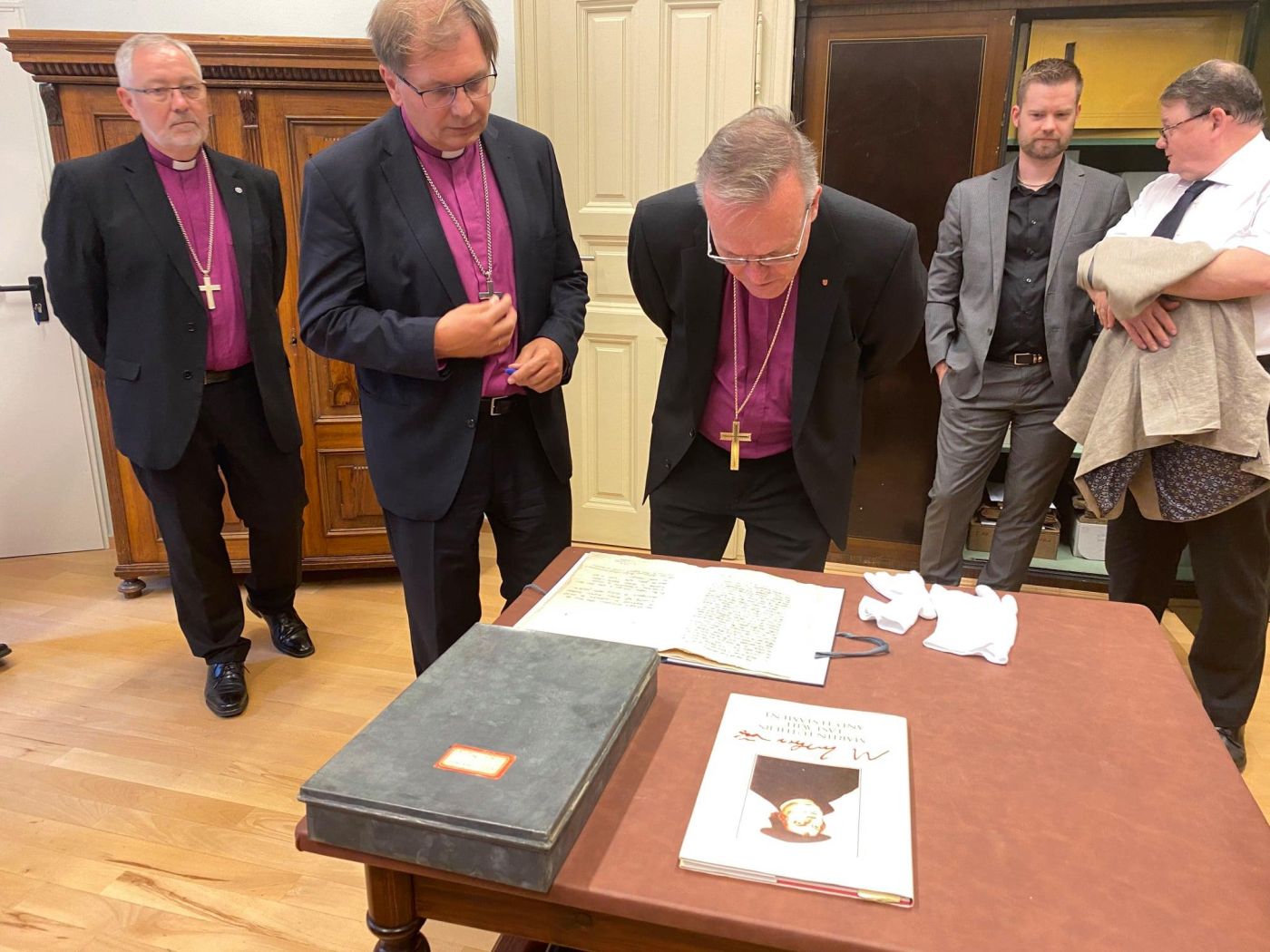
On 15th September, the delegation consulted the ELCH leadership in the Administrative Centre of the church. The guests took a tour of the church archives and the Podmaniczky-Degenfeld Library and saw the original hand-written Last Will of Martin Luther.
The afternoon was dedicated to the seminar “The Role of Minority Churches in a Multicultural Europe of the 21st Century”, an event organized jointly by FinnAgora cultural institute and the ELCH. As one of the speakers, the Archbishop addressed the question “How do Christian churches respond to the present day search of new forms of spirituality”. Also referring to the new strategy (“Open Doors”) of the ELCF, he pointed out that the church needs to find the language that modern-day people speak and engage in dialogue if it wants to respond to the spiritual needs of the society. Although formal membership in the church is declining, interest in the transcendental is not.

The Archbishop’s presentation was followed by Presiding Bishop Tamás Fabiny’s input focusing on Christian compassion and understanding in a multicultural Europe. Fülöp Kocsis, Archbishop of the Byzantine Catholic Church of Hungary, gave an account of the history and role of the Hungarian Greek Catholic church as a bridge between East and West. Klára Keveházi, Director of Humanitarian and International Development of the Hungarian Interchurch Aid (HIA) spoke about the ways an ecumenical aid organization can promote solidarity in a multicultural setting. Finally, Dr. György Fábri, a Professor of Sociology at ELTE University and Lay Leader of the Northern Diocese of the ELCH, presented some statistics and statements in his overview of the role and situation of minority churches in the Hungarian context. He drew attention to the fact that churches need to find their focus (Jesus Christ) if their mission is to remain relevant to the society around them.
After the presentations, the speakers participated in a panel discussion moderated by Metropolitan Ambrosius, President of FinnAgora.

On the third day, the delegation started with a brief visit to Deputy Prime Minister Zsolt Semjén. After this meeting, the program continued on a less official note in Pestszentlőrinc, where the guest were introduced to the life and activities of the local congregation as well as the Gábor Sztehlo Lutheran Primary and Secondary School. The students showed them around the building and entered into lively conversation with the Archbishop and his company, who then rounded off the day by participating in an ecumenical worship in the Castle Hill Lutheran Church. The bilingual liturgy was executed by members of the Finnish delegation and other ecumenical guests including Ferenc Cserháti on behalf of the Roman Catholic Church, József Steinbach and János Jákob from the Reformed Church and Vilmos Fischl, General Secretary of the Ecumenical Council of Churches in Hungary. In his sermon, Archbishop Luoma preached about the reward of discipleship and emphasized that we need to change our perspectives and rethink our priorities. “The calling of the church is not to secure its own interests but to seek the good of the Other”, Luoma said.